

Buy-and-build · AI transformation
AI-enabled roll-up: definition, European examples and how it works in Germany
Daniel Szabo, Managing Partner · Last updated 24 October 2026
An AI-enabled roll-up buys several small companies in one service sector and runs them on shared AI tools, processes and back office. The value comes from making each company more productive. Generation Tech Partners follows this approach in Germany with a fund of more than €60m.
B2B services · EBITDA €0.5m to €5m · Germany · Succession / majority · profitable, owner-managed · Response usually within 72 h · Fund more than €60m
Summary
Key takeaways
- An AI-enabled roll-up buys several service companies in one fragmented sector and runs them on a shared AI, data and process layer. Value comes from productivity per employee.
- Three kinds exist: software-first platforms (including the build variant that founds its own licensed firm), buyout-first owner-operators, and conventional private equity with an AI programme. They carry the same label and different risks.
- In Europe, Dwelly (UK) and Buena (Germany) are venture-backed software-first platforms. Integral and Taxforce (Germany) build their own AI-run firms and buy selectively. Generation Tech Partners (Hamburg) is a buyout-first private equity owner-operator.
- Published third-party targets for the model are 30 to 40% EBITDA margins against 8 to 15% in traditional services. We underwrite measured productivity per workflow and no margin re-rating.
- In a Harvard Business Review study, more than two-thirds of roll-ups failed to create value for investors. The failure modes are known. The section “Where AI-enabled roll-ups fail” lists them with sources and what we do about each.
Definition
What is an AI-enabled roll-up?
An AI-enabled roll-up is a buy-and-build strategy. A buyer acquires several companies in one fragmented service sector. It then runs them on a shared layer of AI tools, data and processes. Each company keeps its name and clients. What changes is the work behind the service. Documents, invoices, reports and client requests go to software first. People step in where judgement is needed.
The model earns its return from productivity inside each company. That is the whole difference from a classic roll-up, and it decides how the deal is run.
Other names for the same idea: AI roll-up, AI rollup, AI-native holding company, services-as-software, and in German KI Buy-and-Build.
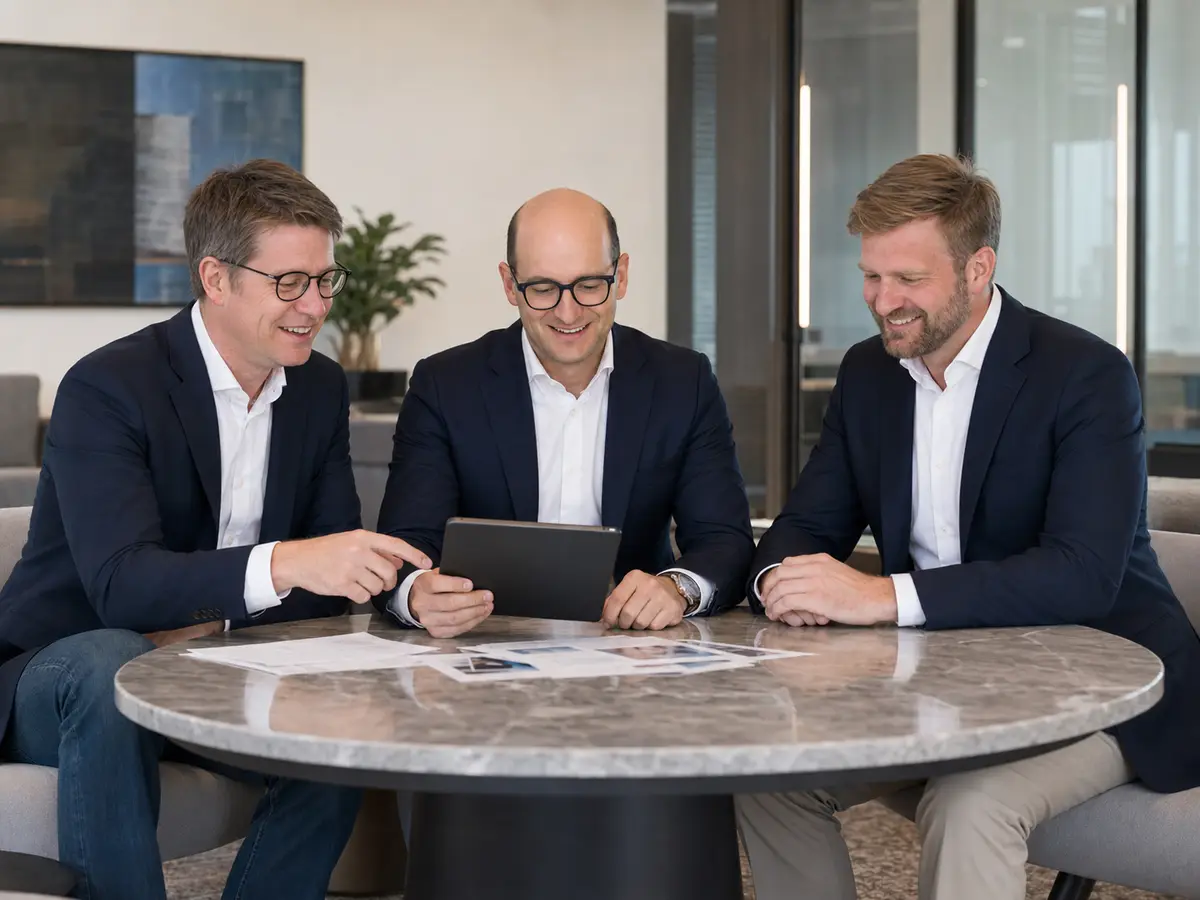
One team, one AI setup, several companies.
Models
Three kinds of AI-enabled roll-up
The label covers three operating models. Anyone comparing platforms, or selling a company to one, should know which one they are looking at.
| Model | How it starts | Who does it in Europe | Funded by | Main risk |
|---|---|---|---|---|
| Software-first platform | Builds software, then buys service firms to run on it (a variant builds its own licensed firm and buys selectively: Integral, Taxforce) | Dwelly, Buena; Integral, Taxforce | Venture capital, venture debt | Burns cash until acquisitions pay back the platform |
| Buyout-first owner-operator | Buys a profitable company, then adds the AI layer and further companies | Generation Tech Partners | Private equity fund | Productivity gains that stay in pilots |
| Conventional private equity with an AI programme | Classic buyout, AI as one of several value plans run by consultants | Large buyout funds | Private equity fund | AI stays a cost line, not an operating model |
Caritas Venture Co. grades 46 firms and uses a similar split: integrated owner-operators, transformation partners, conventional PE with AI programmes (Caritas, updated 23 September 2026). L40 splits the field into AI-focused, AI-enabled and AI-native software holding companies (L40, published 1 July 2025, updated 6 August 2026).
Comparison
Classic buy-and-build versus AI-enabled roll-up
| Classic roll-up | AI-enabled roll-up | |
|---|---|---|
| Where the value comes from | Scale: joint purchasing, one back office, a bigger company that sells for more | Productivity per employee in every company of the group |
| What the companies share | Brand, back office, financing | Data model, AI workflows, process standards, finance and IT |
| Role of the first acquisition | The largest piece | The test site for the operating model |
| How success is measured | Group revenue | Hours per case, error rate and turnaround time, before and after, per workflow |
| Typical failure | Integration costs eat the margin | AI pilots that never reach daily operations |
| The seller after closing | Leaves at closing | Stays 6 to 24 months as managing director |

Timing
Why the model appears now
Language models became good at exactly the work service companies produce in volume. Reading an inspection protocol, sorting tenant mail, checking the fields on a billing claim, drafting the standard report. In 2023 this was a demo. In 2026 it runs in production.
At the same time, Europe's owner-managed service companies are looking for successors in large numbers. In Germany alone, IfM Bonn expects around 186,000 handovers between 2026 and 2030 (IfM Bonn, Daten und Fakten Nr. 37, 2025). KfW Research counts about 109,000 owners a year who want a successor by the end of 2029. Finding a suitable successor is the biggest hurdle: 69% of Mittelstand companies name it (KfW Research, Nachfolge-Monitoring Mittelstand, January 2026).
And investors did the arithmetic. Selling software to a letting agency captures 1.5 to 2% of the agency's P&L. Owning the agency captures all of it. One of Dwelly's founders gave those numbers to Fortune in February 2026 (Fortune, 25 February 2026). Once that sinks in, the tool vendor becomes a buyer.
Europe
AI-enabled roll-ups in Europe
The table lists European platforms that call themselves AI-enabled or AI-native roll-ups and have published figures. Figures are company statements as reported, unless marked. Generation Tech Partners appears in this table; its figures are our own. Last checked 23 October 2026. The full dataset with status labels per row is in the European AI Buyout & Roll-up Index.
| Platform | Country | Sector | Model | Published figures | Source |
|---|---|---|---|---|---|
| Dwelly | United Kingdom | Residential lettings | Software-first | $170m Series B (July 2026): $95m equity led by EQT Growth with General Catalyst, $75m debt from Trinity Capital. More than $260m raised in under a year. More than 15,000 properties. Tenant found in under two days instead of about three weeks (per General Catalyst, April 2026). Maintenance cases closed in 20 days instead of about 50 (company figure, February 2026). | TNW, 28 July 2026; General Catalyst, 8 April 2026; Fortune, 25 February 2026 |
| Buena | Germany | Residential property management | Software-first | 20 property managers acquired since 2023, about 60,000 units (July 2025). $26.5m Series A led by GV, $58m raised in total. Germany has more than 30,000 property management firms averaging about five employees. | Sifted, 23 July 2025; Tech.eu, 23 July 2025 |
| Integral | Germany | SME accounting, tax, payroll | Build (own firm on AI, selective acquisitions) | Builds its own licensed firm on AI agents. One acquisition (cleverlohn, November 2025). €18m Series A, more than €30m raised in total. | EU-Startups, 16 September 2026 |
| Taxforce | Germany | Tax advisory | Build (own firm on AI) | AI-native tax platform. First investment of Tenet, €5m. | Tech.eu, 18 February 2026 |
| Tenet | Germany, Berlin | Investor: accounting, IT, insurance services | Investor in software-first platforms | Target fund €80m, about a third raised at launch. About €5m per deal. | Tech.eu, 18 February 2026 |
| Generation Tech Partners | Germany, Hamburg | Investor: B2B services, four core sectors | Buyout-first owner-operator | GTP 26 closed October 2026 at more than €60m. Majority buyouts of owner-managed companies with EBITDA of €0.5m to €5m. One platform, then add-ons, on a shared group layer for finance, IT and AI. | GTP press; Tech.eu, 10 June 2026 |
Full dataset: every entry of the European AI Buyout & Roll-up Index with status label, source and CSV/JSON download.
Read the table from the right. Dwelly, Buena and Integral started as software companies and then began buying firms. They grow fast and spend venture money to do it. Generation Tech Partners starts the other way round. We buy a company that already earns money. Then we bring the AI layer in. That is slower and cash-generative from day one. Both approaches carry the label AI-enabled roll-up. They are different investments with different risks.
The term comes from the United States. General Catalyst gave the model its best-known form, the Creation strategy, and backs Eudia, Crescendo and Long Lake (General Catalyst, 8 April 2026). Thrive Holdings raised $2bn at a $12bn valuation in August 2026 and holds more than 70 businesses (Caritas, updated 23 September 2026). OpenAI took an equity stake in December 2025 (Capital Founders, updated 11 October 2026).
Economics
The economics: what is claimed, and what we underwrite
Published targets from the US playbooks are consistent. Traditional service businesses run at 8 to 15% EBITDA margins (ProxDeal, updated 26 June 2026). General Catalyst targets 30 to 40%, and its “Rule of 60” asks for 10 to 20% growth on top (Capital Founders, updated 11 October 2026). General Catalyst screened more than 70 service industries. It chose about ten where 30 to 70% of tasks could be automated (Capital Founders, same source).
The open question behind those targets is whether a service business with software-like margins also gets a software-like valuation. That re-rating is the bet of the venture-backed model. We do not make it. Returns in our model come from earnings growth: more cases per employee, fewer errors, shorter turnaround, in each company, measured. We treat multiple expansion as upside and leave it out of the plan. Why we chose a fund over a software platform is on Why a fund.
Risks
Where AI-enabled roll-ups fail
Roll-ups have a poor base rate. A Harvard Business Review analysis found that more than two-thirds of roll-ups failed to create value for investors. A CapitalPad/BCG/HHL dataset shows 35.5% IRR for buyouts with one or two add-ons against 19.9% with more than two. Thrasio raised more than $3bn to roll up Amazon sellers and filed for Chapter 11 in February 2024. In the AI Roll-up Nexus investor survey of 2026, 102 investors answered. 79% named integration the top risk. 68% called AI value “overhyped”. The survey was published by Tenet, an investor in the model listed in the table above. All four figures as cited in Caritas, Do AI rollups work?, 2 September 2026.
| Failure mode | What it looks like | What we do about it |
|---|---|---|
| Pilot that never reaches operations | AI demos, no change in daily cases | Baseline per workflow before any tool; AI goes where the hours are; adoption is measured weekly |
| Integration eats the margin | Systems merged, people leave, clients notice | Companies stay independent; only finance, IT and AI sit at group level |
| Too many add-ons too fast | Platform team overwhelmed, quality drops | One platform per sector; add-ons only after the platform's workflows are measured |
| Owner leaves at closing | Knowledge of clients and cases walks out | Owner stays 6 to 24 months as managing director |
| Unaudited productivity claims | “Margins doubled” without a baseline | A defined method (GTP AI efficiency score), a measured baseline per workflow, before and after |
Germany
AI roll-up in Germany: why B2B service companies fit
A property manager answers the same owner questions a hundred times a month. A testing company writes the same report structure for every inspection. A billing service checks the same fields on every claim. The contracts recur, the markets are fragmented and most of the hours go into administration. That is where software takes hours out of the day and leaves the service intact.
Germany has more than 3.4 million companies, most with fewer than 50 employees (ProxDeal, updated 26 June 2026). In property management, 90% of firms earn under €5m a year; in SME accounting, 40% earn under €3m (General Catalyst, 8 April 2026). The succession figures above are the reason a Hamburg private equity firm can build an AI-enabled roll-up without ever leaving the country.
| German service sector | Active AI roll-up platform (published) | In GTP's focus |
|---|---|---|
| Property management and rental management | Buena | Yes, within real-estate-related services |
| Tax advisory and accounting | Integral, Taxforce | No |
| IT managed services | Tenet (investor focus) | No |
| Staffing | None published | No |
| Engineering and technical planning | None published | No |
| Facility management and building services | None published | Adjacent, within real-estate-related services |
| Testing, inspection and certification | None published | Yes |
| Non-medical healthcare services (billing, back office) | None published | Yes |
| Industrial service and maintenance | None published | Yes |
Sector list after ProxDeal (six sectors across Germany, Austria and Switzerland) and our four core sectors. “None published” means no platform with public figures as of 23 October 2026, not that none exists.
Approach
How Generation Tech Partners runs an AI-enabled roll-up
We buy. A managing director runs the day-to-day business with the existing team; Generation Tech Partners supports on the advisory board and builds the AI setup itself.
01
Buy a first company
A profitable, owner-managed B2B service company in one of our four core sectors, with EBITDA of €0.5m to €5m.
02
Keep name and team
The company keeps its name, its customers and its people. The former owner usually stays on as managing director for 6 to 24 months.
03
Map the work
In the first months we map where time goes: documentation, invoicing, scheduling, customer communication, reporting.
04
Build shared AI tools
We introduce AI for the repetitive parts and train the team to use it. Results are measured against the starting point.
05
Add companies
Further companies from the same sector join the same tools and back office, and gain from what already works.
Four things we do differently from the standard playbook:
One group layer from day one. Finance, IT and AI sit at group level starting with the first platform. Every add-on plugs into that layer. Nobody rebuilds it.
We measure before we automate. Every workflow gets a baseline: hours per case, error rate, turnaround time. AI goes where the baseline shows the most hours. The method is published as the GTP AI efficiency score.
People keep the judgement calls. Dispute resolution, client escalations and technical sign-off stay with people. AI prepares the decision and a person takes it.
The owner stays, usually 6 to 24 months as managing director, the team stays and the company keeps its name. We typically hold a company for one fund generation, and longer when it is strong.
Examples
Where AI changes the work in service companies
The use cases differ by sector. Typical starting points:
01
Real-estate-related services
Owner and tenant communication, invoice processing, preparation of owners' meetings and annual statements.
02
Compliance, testing and certification
Drafting of test and audit reports, scheduling of recurring inspections, document checks.
03
Non-medical healthcare services
Plausibility checks in billing and coding, handling of queries, documentation for practices.
04
Industrial service and maintenance
Dispatch planning, test protocols, spare-parts and service reports.
The four core sectors are our focus. We also invest in other profitable B2B service businesses that meet our criteria.
For owners
Five questions an owner should ask any AI roll-up buyer
- 1. Who builds the AI workflows, by name? If the answer is a consultancy, you are talking to a classic buyout. At GTP, Managing Partner Daniel Szabo and the team at group level build them.
- 2. What is the baseline, and who measures it? Ask for the metric definitions before closing. We measure the three metrics above per workflow; the method is published as the GTP AI efficiency score.
- 3. What happens to my name, my site and my team? All three stay in our model. Ask every buyer the same and get it in the contract.
- 4. How long do you want me to stay, and in what role? Usually 6 to 24 months as managing director at GTP. A buyer who wants you out at closing wants your client list rather than your company.
- 5. How fast do you decide, and how long to closing? We reply within 72 hours as a rule. Closing usually takes 6 to 9 months from the first call.
Caritas and L40 publish similar checklists for sellers; the questions above are the ones we get asked most.
Boundaries
What an AI-enabled roll-up is not
It is not a quick flip. We usually hold a company for one fund generation and are open to holding strong companies longer.
It is not a platform that lists companies for sale. Generation Tech Partners is the buyer and invests from its own fund.
Acquisition profile
Which companies we buy
We acquire: B2B services · EBITDA €0.5m to €5m · Germany · Succession / majority · profitable, owner-managed
You get: Response usually within 72 h · Fund more than €60m
What we do not acquire:
Sectors
Sectors we do not buy
- Software companies
- IT system houses
- Marketing and advertising agencies
- Law and tax firms
- Care services
Situations
Situations we do not buy into
- Turnaround cases
- Brokers without a managed portfolio
Sources
Sources
- TNW, 28 July 2026: Dwelly $170m Series B
- Fortune, 25 February 2026: Dwelly Series A and operating figures
- General Catalyst, 8 April 2026: Europe's AI Transformation in Services
- Sifted, 23 July 2025: Buena Series A and Tech.eu, 23 July 2025
- EU-Startups, 16 September 2026: Integral Series A
- Tech.eu, 18 February 2026: Tenet launch
- Tech.eu, 10 June 2026: Generation Tech Partners first close
- Capital Founders, updated 11 October 2026: Founder's Guide to AI-Enabled Roll-Ups
- ProxDeal, updated 26 June 2026: AI roll-ups in DACH
- Caritas Venture Co.: market map, updated 23 September 2026 and bear case, 2 September 2026
- L40, published 1 July 2025, updated 6 August 2026: AI Rollups in 2026
- IfM Bonn: Daten und Fakten Nr. 37 (2025), Nachfolgeschätzung 2026 bis 2030
- KfW Research: Nachfolge-Monitoring Mittelstand, Fokus Volkswirtschaft Nr. 526, January 2026
Changelog
Changelog
- 24 October 2026: Linked the published method (GTP AI efficiency score) and the new pages Provider or payer, AI after closing and Why a fund.
- 23 October 2026: Added three-model taxonomy, economics, failure modes, seller questions, updated Dwelly and Buena figures, linked all sources.
- 26 September 2026 (first version): definition, German fit, GTP process, FAQ.
Questions and answers
Frequently asked questions
- What is an AI roll-up?
- An AI roll-up, also written AI rollup or AI-enabled roll-up, is a buy-and-build strategy. A buyer acquires several companies in one fragmented service sector and runs them on a shared layer of AI tools, data and processes. The return comes from higher productivity per employee in each company, not from size alone.
- Which firms are building AI-enabled roll-ups in Europe?
- Dwelly in the UK (lettings), Buena in Germany (property management), Integral and Taxforce in Germany (accounting and tax). Their backers include General Catalyst, EQT Growth, GV and Tenet. Generation Tech Partners runs the model as a private equity buyer in German B2B services. Figures and sources are in the table above.
- Is an AI-enabled roll-up the same as buy-and-build?
- It is one form of buy-and-build. The difference is where the return comes from. An AI-enabled roll-up earns from productivity per employee through a shared AI layer, measured per workflow, rather than from scale alone.
- What is the difference between an AI roll-up and a software company selling to service firms?
- A software vendor earns a licence fee. A roll-up owns the company and keeps the whole productivity gain. That is why several software founders in Europe became buyers.
- What is an AI-native holding company?
- A holding company that owns several service businesses and runs them on one AI operating layer from the start. Another name for the software-first kind of AI-enabled roll-up.
- Do AI-enabled roll-ups get software valuations?
- Not so far. Listed services groups trade at far lower valuations than listed software companies (Caritas, 2 September 2026). Caritas's verdict: the valuations price a re-rating that the evidence has not yet earned. We plan without the re-rating. Returns in our model come from earnings growth; multiple expansion is upside.
- Do AI-enabled roll-ups work?
- Some do. Roll-ups as a class have a poor record, and AI does not change the integration risk. The models with published before-and-after figures per workflow are the ones to take seriously. See “Where AI-enabled roll-ups fail” above.
- What happens to employees after the acquisition?
- The team stays. AI takes over repetitive tasks, and we train employees to work with the new tools.
- How long does it take from first call to closing?
- Closing usually takes place 6 to 9 months after the first call.
- Does Generation Tech Partners buy companies outside Germany?
- We buy owner-managed B2B service companies in Germany. Our investors come from Europe and beyond.
- How fast do you respond to an enquiry?
- We usually reply to an enquiry within 72 hours.
Let's talk
The first call takes 30 minutes and stays confidential. You speak directly with a Managing Partner.
Request a confidential first callCONFIDENTIAL · NON-BINDING · GERMANY-WIDE